19/10/2026 15:43
Did the Caption Name the Wrong Part? A TikTok Workflow for Cambodian Bicycle Shops

A bicycle demonstration can look clear while its captions tell customers something different. A mechanic might speak Khmer, use an English component name, then read a model code from a packet. If the text changes that code or misses a word such as “not,” viewers may misunderstand which part the shop can supply. Promoting the clip more widely would spread the confusion. For Cambodian bicycle businesses, the useful question is therefore specific: can someone watching without sound identify the part and understand what information to send the shop? This workflow follows a hypothetical Phnom Penh repair shop preparing a TikTok explanation about identifying an inner-tube valve before an enquiry. It combines a technical wording check, a practical captioning decision and a customer comprehension test. It also explains where an SMM-panel service fits into that decision—and why purchased engagement cannot prove that the explanation works.
1. Define the customer decision before recording
Start with one task the viewer should be able to complete. In this hypothetical example, the task is to photograph the valve and tyre marking so the shop can discuss a replacement tube. The video is not a complete fitting guide, a promise of compatibility or a diagnosis of every puncture. Write that boundary into the script before recording. Otherwise, a short caption may accidentally turn a limited demonstration into a general recommendation.
Choose an ending that produces useful information: ask viewers to send a clear valve photo and the tyre marking through the shop’s stated enquiry route. Explain that the shop will check the details before confirming availability or suitability. Avoid asking people to post phone numbers or other personal information in public comments. The video succeeds as an explanation when a viewer understands what to show, what remains uncertain and what the shop will do next.
2. Build a small reference sheet for risky words
Before filming, list the words that could change the customer’s decision if transcribed incorrectly. Include component names, model codes, sizes, units and negative statements. For each entry, record the wording the mechanic intends to say, the approved spelling and the object or packaging used to verify it. Keep this sheet short enough to use beside the editing screen. A photograph of the actual label is more useful than someone’s recollection of a similar product.
For Khmer speech containing borrowed technical terms, ask a fluent reviewer which wording customers will recognise. Preserve a genuine product code exactly instead of translating it into a different identifier. If a familiar spoken term could refer to several components, pair it with a clear close-up and a brief explanation. Do not invent a universal Khmer translation merely to make the captions appear consistent. Resolve uncertainty with the mechanic before approving the text.
3. Record speech that can be checked
Film the explanation in short, complete thoughts. Let the mechanic finish naming the object before changing the camera angle. Record away from avoidable workshop noise, and replay a sample through an ordinary phone speaker. If the reviewer cannot confidently hear a term, improving the recording is usually more dependable than guessing what an automatic transcript intended. Keep music from competing with the words needed to understand the demonstration.
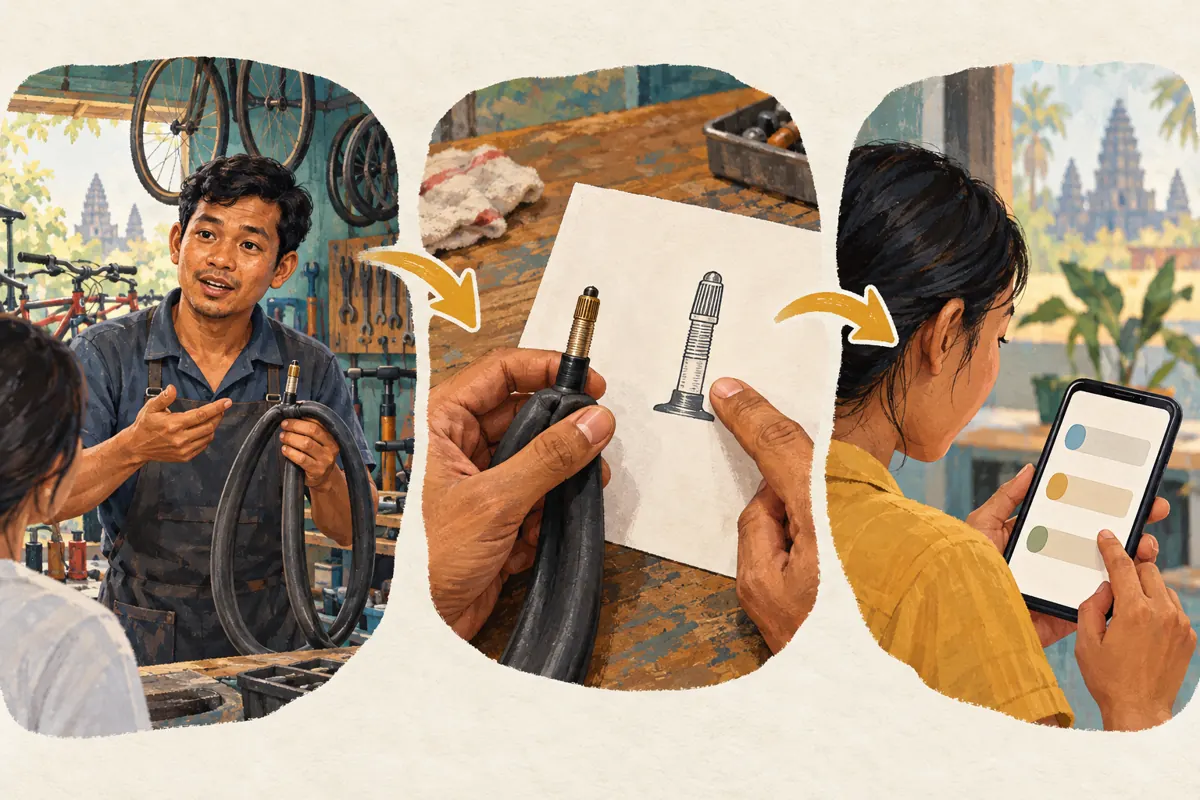
Show the component at the moment it is named. In the hypothetical valve video, the presenter first shows the whole wheel, then the valve, then the tyre marking needed for the enquiry. Leave each detail visible long enough to inspect. If the presenter says a code incorrectly, record that sentence again rather than silently putting a different code in the captions. Speech, pictures and text should support the same explanation.
4. Choose a caption method without assuming Khmer support
TikTok’s official accessibility guidance describes creator captions that transcribe speech and allow creators to edit the resulting text. Its TikTok Studio guidance also lists adding and editing auto captions. These features provide a starting point for review; they do not establish that every language, technical term or mixed-language recording will work correctly. Check the tools and language options actually offered for your video.
Try the available caption function on a short sample containing the difficult words. If it produces useful text, review and correct the complete transcript. If the required language is unavailable or the result is unreliable, prepare manually checked captions in your video editor before uploading. Do not select an unrelated language simply to obtain a transcript. Keep a clean original and an editable caption copy, and inspect the exported video for broken characters, misplaced marks or unexpected line wrapping.
5. Separate transcription errors from mistakes in the explanation
Run two distinct checks. First, compare the captions with the recording: did the text accurately represent what was said? Second, compare the explanation with the component and reference sheet: was the statement itself correct? Accurate transcription cannot repair inaccurate speech. A caption that perfectly repeats a mistaken compatibility claim still needs the mechanic’s attention.
In a hypothetical review, the speaker says that appearance alone does not confirm compatibility, but the caption drops “not.” That is a transcription error with a practical consequence. In another hypothetical case, both speech and captions identify the wrong component. That requires correcting the explanation, potentially by recording again. Prioritise negation, quantities, units and conditions before polishing punctuation. Ask the technical reviewer to approve these passages explicitly rather than assuming a general “looks fine” covers them.
6. Keep captions away from the evidence
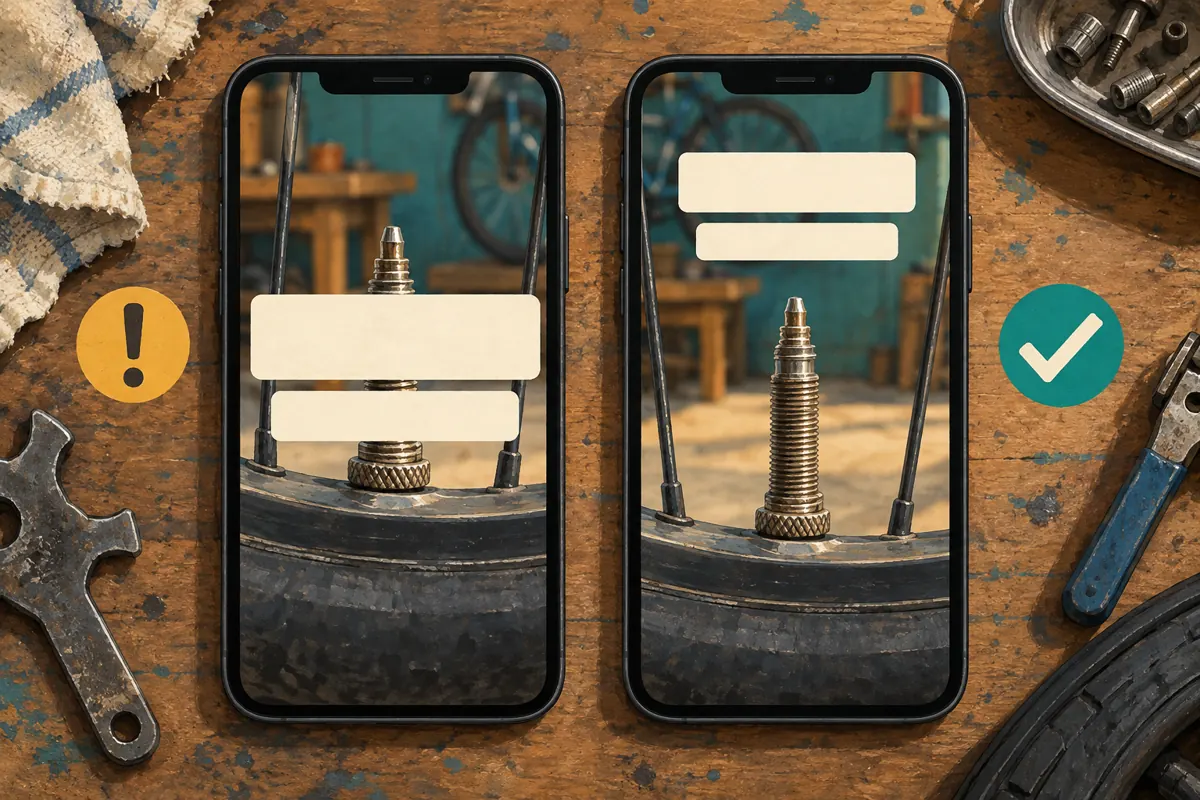
The caption must not hide the detail it explains. Check the valve tip, tyre marking, connector or model label throughout the clip, including moments when hands move across the frame. Place text in a relatively quiet area of the image with enough contrast to read comfortably. If there is no suitable space, reframe the shot or insert a separate close-up instead of shrinking the lettering until it becomes difficult to read.
Review the video on a phone at normal viewing size. Where you control caption timing, divide long speech into meaningful phrases rather than arbitrary fragments. Give viewers time to read and inspect the part. Avoid crowding every frame with both a full translation and a full original-language transcript. If two language versions are necessary, consider separate carefully reviewed edits. Inspect the actual TikTok presentation as well, because surrounding interface elements can compete with important details.
7. Test understanding with the sound off
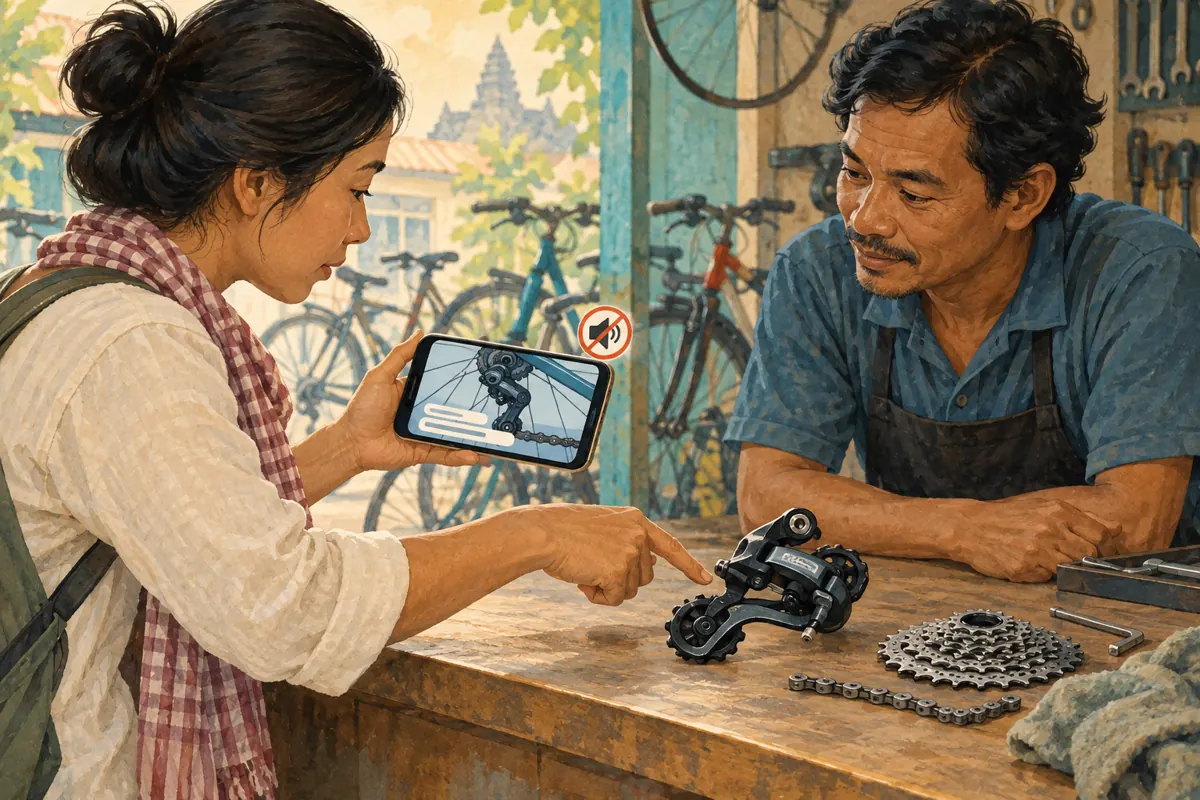
Ask someone who did not write the script to watch without sound. Do not explain the intended answer first. Afterwards, ask which object the video discussed, what information they would send and whether the clip confirmed that a replacement would fit. Their explanation reveals misunderstandings that a spelling review cannot catch. A colleague can perform this check, although someone unfamiliar with bicycle terminology may expose different problems.
Treat this as a small editorial test, not customer research proving market demand. If the reviewer identifies the valve but misses the tyre marking, inspect the ending and the shot that shows it. If they believe a purchase is already confirmed, strengthen the qualification. Change the specific passage responsible and repeat the relevant check. Avoid rewriting the whole video simply because one person prefers a different style; focus on errors that affect the next action.
8. Make the SMM-panel decision after the explanation works
The supplied bongsmm.com catalogue includes “TikTok - Video Views ~ Max 10M ~ 20k-50k/Days ~ Instant ~ 𝗥𝗘𝗙𝗜𝗟𝗟 30D”. Its title identifies a video-view offering, but the supplied description is empty. The speed, capacity and refill wording should not be treated as independently verified delivery promises. Nothing in that information establishes caption review, Cambodian audience targeting, customer comprehension or sales.
TikTok’s Community Guidelines prohibit services that artificially boost engagement or manipulate recommendations. That policy matters before any purchasing decision. For this workflow, the sensible choice is to resolve caption problems and pursue genuine distribution rather than buy views as a test of clarity. Purchased engagement is not evidence of genuine interest, ad delivery, Cambodian users or repair bookings. If a panel order already exists, retain its record separately; a delivery status cannot establish that anyone understood the valve explanation.
9. Publish a useful explanation and handle corrections clearly
Before publishing, have the mechanic approve the technical content and a fluent reader approve the language. Check the contact instruction against the route the shop actually monitors. For promotional business content, follow TikTok’s content disclosure requirements. Keep the approved script, reference sheet and captioned export together so a later correction can be traced to the right version.
After publication, read genuine questions for signs of confusion. A question asking where to find the tyre marking may suggest that the close-up needs improvement; it does not prove that every viewer missed it. If an error changes suitability, price or the required next step, pause further promotion and correct the content through the options available. If correction requires a replacement upload, update the links your shop controls. Do not rely on a buried comment to undo a materially misleading video.
10. Review the outcome without inventing a success story
Use a simple enquiry note to record what customers actually supplied: a valve photograph, a readable tyre marking, an incomplete description or a question the video should have answered. Record the customer’s stated source when they volunteer it. Do not assume every later enquiry came from TikTok. Keep personal customer details out of editorial review documents whenever a short anonymous summary will do.
Common mistakes include approving captions because they look fluent, allowing a code to change between shots, hiding the part under text and treating a larger view count as proof of understanding. Review the video against its original task instead. If enquiries repeatedly lack one necessary detail, improve that instruction in the next version. If the explanation is clear but receives little attention, investigate distribution separately. Caption accuracy, audience reach and commercial results are different questions requiring different evidence.
Frequently asked questions
Can we assume TikTok will automatically caption our Khmer explanation correctly?
No. Check the language options and test the actual recording. The official sources used here establish captioning and editing features, but do not establish dependable Khmer transcription for your account or video. Mixed technical language needs human checking even when a transcript looks fluent. Use manually reviewed captions when the available tool does not produce a reliable result.
Should we translate every English bicycle part name into Khmer?
Use wording your intended customers can understand, supported by a clear image of the component. A fluent reviewer and the mechanic should agree on ambiguous terms. Preserve genuine model codes and identifiers accurately. If a translated term could confuse the customer, explain it briefly rather than substituting an unfamiliar expression without context.
Is text added in a video editor the same as an editable platform caption track?
No. Text rendered into the exported picture becomes part of the video image. Changing it requires editing and exporting that asset again. A platform caption feature may provide separate editing controls. Keep the original footage and editable caption project so you can correct either approach without reconstructing the entire demonstration.
Will more purchased views show whether the captions are effective?
No. A purchased view count cannot demonstrate that someone read the captions, identified the component or intended to contact a Cambodian shop. Use a comprehension check and genuine enquiry observations for those questions. Consider TikTok’s rules on artificial engagement before any panel purchase; a catalogue listing does not establish platform approval.
What should we fix first if the video contains several errors?
Start with errors that could change a customer’s action: an incorrect component, missing qualification, wrong code or misleading compatibility statement. Then fix readability and timing. Cosmetic punctuation comes later. If the spoken explanation is wrong, correct that too; displaying accurate captions over contradictory speech leaves viewers with two competing messages.
Explore the current service catalogue, create an account, or ask a specific question through support tickets.
- TikTok: Inclusion and Belonging Guide — accessibility and creator captions
- TikTok Help Center: TikTok Studio — auto captions
- TikTok Community Guidelines — artificial engagement and commercial disclosure
Prepared with AI assistance. Illustrations explain the workflow and do not represent customer results.