19/10/2026 08:39
Which Promotion Brought Telegram Joiners? An Invite-Link Workflow for Cambodian Bookshops

A Cambodian bookshop might promote the same weekend sale through its counter display, a social post and a neighbouring café. If every placement uses the same Telegram invitation, the owner has little evidence about which route people used to join. Separate invite links make that question easier to investigate. They do not establish why someone joined, where that person lives or whether they bought a book. This workflow shows how to organise invitations around a practical business decision, maintain them during a promotion and interpret the results responsibly. It also explains why an SMM panel member service cannot substitute for evidence that a local promotion attracted interested readers.
1. Start with the decision the promotion should inform
In a hypothetical example, a Phnom Penh bookshop wants to decide whether to repeat a café partnership for its next used-book weekend. It already has a Telegram announcement channel. The immediate question is whether people use the café invitation; the broader question is whether the partnership generates useful enquiries or visits. These require different evidence.
Write the decision before creating links: continue the café placement, revise its invitation or stop using it. Then identify what would help that decision, such as joins through the assigned link, customer questions mentioning the café and the effort required to maintain the display. Avoid making channel membership growth the entire definition of success.
2. Give each meaningful placement its own route
Telegram’s official invite-link guidance describes additional links for groups and channels, optional duration or usage limits, and the ability to inspect who joined through a particular link. These features provide a record of the invitation used. They are useful when several promotions lead to the same destination.
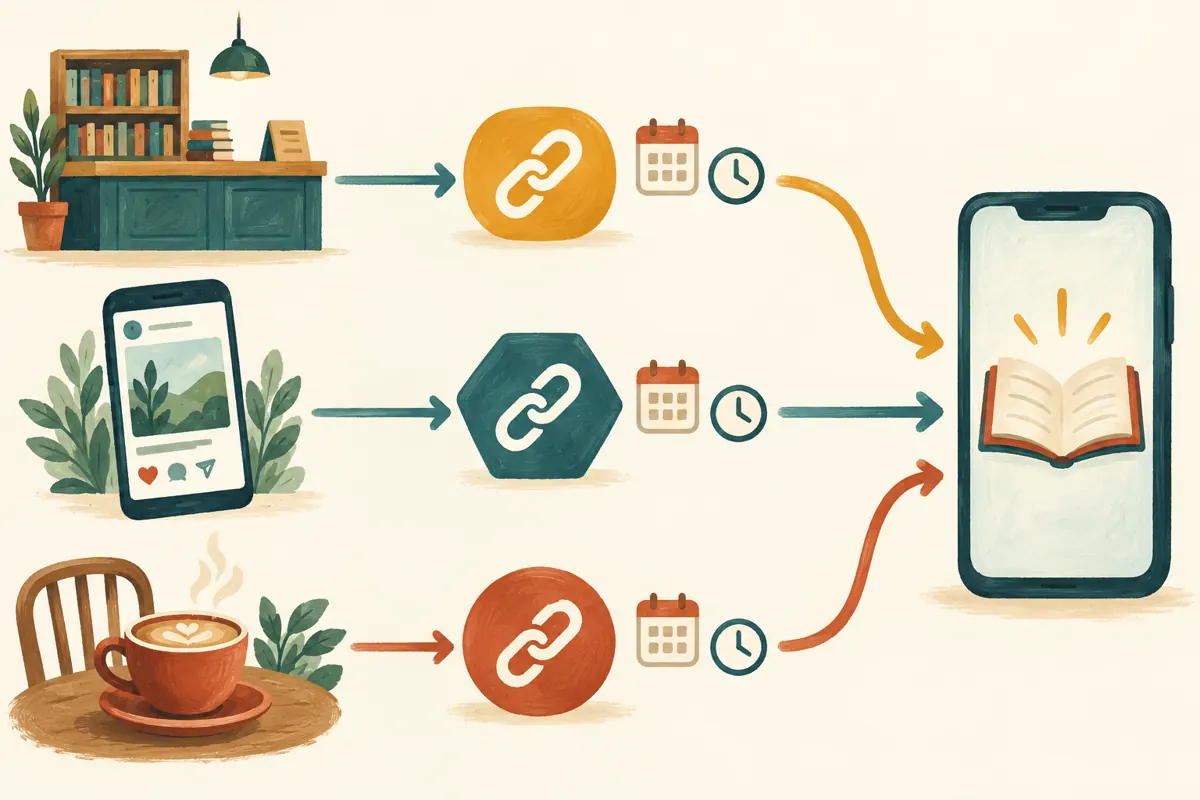
For the hypothetical bookshop, create separate routes for the counter, the shop’s social post and the partner café. Keep the invitation promise consistent: join for the sale’s book previews and practical visiting information. Do not create a different link for every minor wording change unless that distinction will affect a decision. Too many routes create maintenance work without necessarily producing useful comparisons.
3. Name links so another staff member can recognise them
Telegram supports names for additional invite links, and its interface documentation identifies these names as visible only to administrators. Use that space for operational labels such as BOOKS-CAFE-OCT or BOOKS-COUNTER-OCT. A short, recognisable label is easier to review than several unnamed invitation strings.
Keep a small campaign register containing the label, exact invitation, intended placement, responsible person and review date. Add any expiry setting and note when the link actually went live. The public invitation still needs clear wording because customers cannot rely on an internal label to understand the offer. Ask the café contact to use the supplied invitation exactly, then check the finished placement.
4. Choose expiry according to the invitation’s promise
A temporary sale invitation and a permanent bookshop invitation have different maintenance needs. For a temporary placement, choose an end point that leaves reasonable time for customers to act. Record the date and local Cambodia time in the campaign register. Avoid setting an invitation to expire while the partner is still displaying it.
Use a membership limit only when there is a clear operational reason. A link’s join limit is not a stock reservation, ticket allocation or promise that a particular book remains available. If an invitation stops working, customers need another way to contact the shop. Include a readable shop contact alongside temporary promotional material rather than relying entirely on the invitation.
5. Test the actual customer route before distributing it
Open the exact invitation copied into the finished post or supplied to the partner. Confirm the channel identity, image and description. Ask a willing colleague who is not already a member to check the joining experience; an administrator’s existing access does not reproduce every step a newcomer encounters. Identify any test join in your notes.
Then read the first content a visitor encounters. The hypothetical sale channel should explain which books are being previewed, where the shop is and how availability questions are handled. Use Khmer wording where appropriate for the intended customers, with other languages added only when useful. Do not promise instant reservations if staff cannot confirm stock through that route.
6. Distribute carefully and record changes
Treat each invitation as assigned to a placement, not as a general link for staff to reuse everywhere. If the café invitation is also pasted into the shop’s social post, later joins cannot cleanly distinguish those placements. Give collaborators a short instruction identifying where the supplied link belongs and whom to contact for another placement.
Maintain a brief change note when a post is edited, a display is moved or a partner shares the invitation elsewhere. In a hypothetical case, the café might forward its invitation to a reading group. That is useful distribution context, but subsequent joins through that link no longer demonstrate that people saw the café display. Record the forwarding instead of quietly preserving a misleading interpretation.
7. Read joins as route evidence, not customer proof
A join associated with an invitation supports a narrow statement: that account used that route to enter. It does not establish exposure to the original placement. Someone may have received the link from a friend. Nor does it establish Cambodian residence, reading interests, purchasing power or willingness to visit the shop.
Review routes over comparable periods and note obvious differences in opportunity. A counter invitation mainly reaches existing visitors, while a social post may reach people who have never visited. Without reliable exposure figures, raw joins cannot establish which placement has the better conversion rate. Describe what happened, acknowledge missing information and avoid ranking placements with a precision the evidence cannot support.
8. Connect the review to enquiries without tracking people unnecessarily
Keep a separate, minimal record of useful enquiries: the question, whether staff resolved it and any source the customer voluntarily mentions. For the bookshop, useful questions might concern Khmer-language children’s books, collection times or whether a particular edition is available. These reveal content needs that membership totals cannot explain.
At checkout, staff could optionally ask how the customer heard about the sale. Record the answer as self-reported information, not a verified link history. Do not match Telegram accounts to receipts merely to make a campaign report look complete. A practical conclusion might be that the café placement produced availability questions, so its next invitation should explain how to check stock.

9. Keep SMM panel services outside the promotion comparison
The supplied bongsmm.com catalogue includes “Telegram Channel/Group Members ~ Max 1M ~ 500k/days ~ Instant ~ 𝐍𝐎 𝗥𝗘𝗙𝗜𝗟𝗟”. Its title identifies a member-oriented service, but the supplied description is empty. The title alone does not verify delivery speed, audience origin, account quality or suitability for this channel. It also does not establish that an additional invite link is an accepted input.
For a business trying to understand voluntary response to a local promotion, buying members does not answer the research question. Purchased engagement is not evidence of genuine interest, sales, ad delivery or Cambodian users. If panel activity already overlaps the campaign, record it as a separate intervention and limit conclusions accordingly. Do not assume subtracting an ordered quantity from total growth reveals organic growth.
10. Close the campaign and decide what deserves another test
At the agreed review point, note the invitation results and relevant distribution changes before tidying the campaign. Telegram documents that revoked invite links cannot be used to join. Revoking a campaign invitation is therefore a way to close that entrance, not a replacement for removing old displays or updating an outdated offer.
Ask the café to remove temporary material and update any shop-controlled post that still promises the sale. Keep the register so the team can distinguish this campaign from the next one. Choose one improvement supported by the evidence: clearer visiting instructions, a better stock explanation or a different partner placement. If the results are inconclusive, say so and plan a simpler comparison rather than claiming the partnership succeeded.
11. Avoid the mistakes that make link reports misleading
The most common operational mistake is assigning separate labels but distributing the same invitation everywhere. Another is reusing last month’s campaign link and treating all later joins as this month’s result. Verify actual links, not just filenames or notes. Keep the scope small enough that the person responsible can check every placement.
Interpretation mistakes are just as costly. A quiet route may have a broken invitation, weak visibility or an unclear promise; low joins alone cannot distinguish those explanations. A busy route may have been forwarded widely. Before spending more, inspect the customer experience and ask the placement owner what changed. Use the report to choose the next practical action, not to manufacture certainty.

Frequently asked questions
Can one invitation be used for both the counter and the café?
Yes, but then its join record combines those routes. Use separate invitations if the comparison matters to a business decision. If the only aim is to provide a convenient entrance and no placement comparison is needed, maintaining one invitation may be simpler. Choose the structure around the question you actually need answered.
Does a café-labelled invitation prove the person visited that café?
No. The label describes where you intended to distribute the invitation. A customer, employee or partner could forward it elsewhere. Report joins through the café-assigned link, and note any known redistribution. Evidence of a physical visit would require a separate, appropriate source rather than an assumption based on the link.
Should a temporary invite link expire when the sale ends?
That depends on what the invitation promises. Expiry can help close a temporary entrance, but customers may still encounter old material afterward. Coordinate the end time with removal of displays and updates to posts. If ongoing membership remains useful, provide a current invitation with an accurate explanation instead of leaving the old sale promise in circulation.
What should the shop do if a placement brings no recorded joins?
First verify the exact invitation and whether the placement actually appeared. Check expiry, limits and the newcomer experience. Then review visibility and wording with the person managing that placement. No recorded joins do not by themselves prove that nobody saw the promotion, disliked the shop or purchased through another route.
Can SMM member delivery be isolated by giving it a separate link?
Do not assume a service accepts that input or provides complete attribution. Even a separately identified delivery route would not establish genuine interest or customer value. For this workflow, the stronger choice is to evaluate voluntary promotion response without introducing purchased membership. Where activity has already overlapped, disclose the limitation instead of presenting a clean comparison.
Explore the current service catalogue, create an account, or ask a specific question through support tickets.
- Telegram: Auto-Delete, Widgets and Expiring Invite Links
- Telegram API: Invite links
- Telegram API: Edit an exported chat invite
- Telegram interface strings: Groups and channels
Prepared with AI assistance. Illustrations explain the workflow and do not represent customer results.